Wednesday, May 11, 2016
World Orienteering Day TempO
Courtesy of the Hong Kong Orienteering Club. A chance to try some online photo TempO for World Orienteering Day. Thanks, Hong Kong!
Friday, April 8, 2016
2016 U.S. National Trail Orienteering Team Named
The National Team consists of up to 10 members in each class who are highly ranked and/or agree to promote high standards of excellence in Trail Orienteering. This year's team includes ten members who have previously represented the U.S. at the World Championships. Congratulations to all those named.
OUSA 2016 National Trail Orienteering Team:
Open Class
- Karl Ahlswede (DVOA)
- Steve Beuerman (BAOC)
- Joe Brautigam (WCOC)
- Sharon Crawford (RMOC)
- Clare Durand (LAOC)
- Richard H. Ebright (DVOA)
- Richard Yon Ebright (DVOA)
- Jay Hann (BAOC)
- Mika Latva-Kokko (NEOC)
- Mike Poulsen (CROC)
Paralympic Class
- David Irving (SDO)
- Daniel Heimgartner (QOC)
- Glen Cafferty (CROC)
Thursday, March 17, 2016
2016 US National Trail Orienteering Team Application
...
G.4.4 The U.S. Trail Orienteering National Team shall be composed of the 10 highest-ranked applicants from each class in the U.S. Trail Orienteering Rankings who meet the following conditions:
a. Have full passport qualifying citizenship for the United States.
b. Regular member of Orienteering USA in good standing.
c. Agree to be an active part of the team.
d. Participate in Team discussions, elections, and fundraisers.
e. Agree to represent the USA in International Orienteering Events.
f. Subscribe to the Official Team communication channel.
G.4.5 In the event that fewer than 10 applicants for the team in a class have a valid ranking, the ESC may, at their discretion, name non-ranked applicants to the team.
Tuesday, December 1, 2015
Support USA Trail Orienteering
How to Donate:
Orienteering USA's DONATE page provides information for making both online donations and mailing in a donation. Donations must be directed to "Team USA: Trail O Team" to insure that the team receives your support.
![]() |
| USA Team Member Mika Latva-Kokko focuses on a problem while Italian paralympic competitors look on |
Trail Orienteering is a precision map reading competition developed to provide an orienteering discipline for the disabled. The US Trail Orienteering Team fields a squad of both paralympic and open competitors for the World Championships annually. In addition, team members attend National competitions to hone their skills and qualify for the team. Travel and competition costs are born almost entirely by the competitors. Your support helps to defray these costs making it possible for those with limited resources to participate. This is especially critical for those disabled competitors with fixed disability incomes.
We are currently working to recruit new paralympic team members. Funding may be critical to enable potential candidates to afford the travel costs associated with training and competition.
How will my donation be used?
US Trail Orienteering funds may be used for the following purposes:
1) To pay entry and accreditation fees for team members at international competitions.
2) To defray travel expenses for team members at international competitions.
3) To support expenses related to recruitment and training of promising paralympic team candidates.
Thank you for your support!
Thursday, August 6, 2015
Sharon Crawford at O-Ringen
I did find a map posted on WorldofO. This map is not from the Elite Class, but still gives an idea of the terrain from this competition.
Congratulations to Sharon on this competition. I'm sure all of this European experience will make her a more formidable opponent in the upcoming year.
Thursday, July 23, 2015
Final words from WTOC 2015
On our last day in Croatia, I asked the team to share their thoughts about the competition and the future:
Mika Latva-Kokko: Very good problems. A lot of work that I need to do - contour reading, sight lines, sighting to a distance, being more accurate about reading all the stuff on the map when it's needed to figure out the flag. Overall, I'm happy. Every day could have gone better, but all the mistakes I did were my mistakes. Some of them were punching mistakes, some of them were other type of mistakes. They're my mistakes that I can fix for the future. Hopefully, someday we'll get the same level of competition in the US.
David Irving: I thought it was pretty well done, especially after the weekend at Varazdin. They need to do more to speed up at the timed controls - more separation of the Paralympic and the Open. Particularly today at the tempO relay. If they had sent all the third leg runners to the timed controls after the start, you could have got them done instead of stacking everybody up so much that you give up on trying to get the third runners through the timed control.
Karen Dennis: Yeah, I'd like to see them work on the relay some more because that was almost exciting. They need to fine tune it.
Clare: I'm really happy with how I did this year. I mean, it still wasn't close to a podium or anything, but it's been overall just about my best trail-O yet. I don't remember exactly where I landed in the final results in the Czech Republic, but this has definitely been a good one. I was especially happy with my day two Pre-O performance and with the fact that the work I did to increase my speed on the TempO really seems to have paid off. I'm still not way up there, but I can see that there was progress so I'm hoping that continued work will get me further. So I'm looking forward to hopefully making the team again next year and going to Sweden and improving even further. That's my goal.
Sharon Crawford was not available for this interview.
Pictures of the U.S. Team courtesy of the Portuguese orienteering blog
Friday, July 17, 2015
Punch Routine
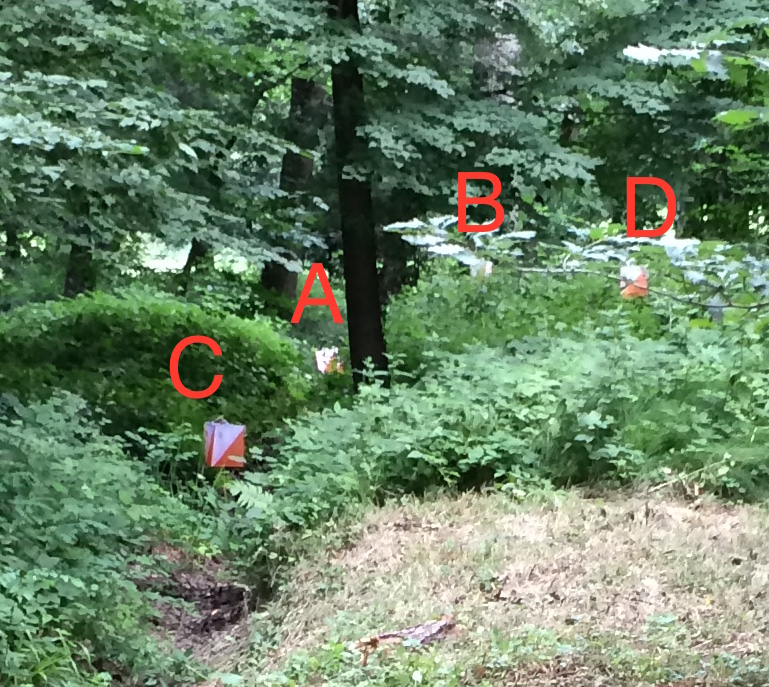
What led to this mistake? Parallax was the culprit. Sharon named the controls based on the view from the punch rather than the viewing station. An easy mistake to make given how close they were to each other, but changing the name of all but one control.
![]() |
| View station and Punch |
![]() |
| View from the view station |
![]() |
| View from the punch |
Foot orienteers often practice their routine for moving through a control site to improve their efficiency and avoid errors. Trail-O is no different. I think it's important to have a punching routine that becomes habit. By punching routine I mean the steps you take between choosing which control answers the problem and punching a box on your control card. Here is a rundown of how I handle this.
- Solve all problems that use the same viewing station and punch.
- Return to the viewing station and properly identify the name of each control.
- Look at the map and check the number of the control(s) that you solved. If there are multiple controls, take note of their proper order.
- From the viewing station, label your answers in the proper order. I might, for example, walk away from the viewing station thinking 4-B, 5-A, 6-Z.
- Proceed to the punch and punch carefully in the proper boxes.
Would love to hear what routines others use to be sure their punch card truly reflects their decisions.